
Q3 Update dated 11/21/25
Palantir reported Q3 earnings earlier this month.
Palantir just posted the single best quarter in its public history:
- $1.181B revenue (+63% YoY, +18% QoQ, +65% ex-strategic deals)
- Rule of 40 at 114% (#1 among >$1B enterprise software)
- Adj. FCF: $540M (46% margin), TTM $2.0B (51% margin)
- Cash & equivalents: $6.4B, zero debt
Breakout between government and commercial – notable increase in growth in commercial, which paints a positive story of government concentration.
- U.S. revenue: $883M (+77% YoY)
- U.S. government revenue: $486M (+52% YoY)
- U.S. commercial revenue: $397M (+121% YoY, +29% QoQ)
Looking at their closed pipeline for the quarter:
- Deals closed: 204 × ≥$1M, 91 × ≥$5M, 53 × ≥$10M
- U.S. commercial TCV: $1.3B (+342% YoY)
- U.S. commercial customers: 530 (+65% YoY)
FY25 guidance is strong, albeit aggressive with commercial expansion.
- Revenue $4.396–4.400B (~53% YoY)
- U.S. commercial >$1.433B (≥104% YoY)
- Adj. FCF $1.9–2.1B, Q4 adj. op margin ~52–53%
Great, they just validated their 500x+ P/E and even Jensen Huang was so excited, he decided to a do a partnership with Palantir based on Karpian ontology.
Ok, is this a long position riding the AI narrative super-cycle now?
No, the short thesis remains.
Ontology is not a Durable Moat
Despite Karp continued marketing of the technical term “ontology” to non-technical retail and institutional investors, and based on my understanding as student of electrical engineering at computer science – I am not an AI engineer in practice – ontology is basically the combination of ETL (extract, transform, load) + Palantir’s own in-house LLM foundational model.
They package this for their signature product known as Palantir Foundry, and have done an incredible job at marketing a product that is based on a standard data science workflow (ETL) and any number of open-weights LLM models available now (DeepSeek).
Did it take them years to train this foundational model? Yes, no doubt that is proprietary and a barrier to entry for other participants. But that in itself, does not constitute a moat in this day and age when it is very easy to harness the SOTA LLM model and build an agent around it – an agent that can do exactly what Palantir Foundry does based upon first order software engineering principles that I learned in undergrad at U.C. Berkeley.
Catalysts
The biggest risk is a what is going come out of the release of the Epstein Files. If it does indeed incriminate Trump (which is unlikely based on the first release), this could have devastating consequences for Palantir’s government contracts.
Yes, many of them are locked in for 5-10 years, but the market is pricing for Palantir to be the AI-enabled intelligent software that will be powering the U.S. government for the foreseeable future – that’s what a 500X multiple is telling investors.
Risks
Key Man Risk
Alex Karp – the founder and CEO – has developed the personality of the “misunderstood genius tech founder who is developing the operating system that will power all of AI.” No one recognizes the incredible genius behind his seminal idea of “ontology” – which by the way is a subfield in philosophy and complement to the field of epistemology. Not a lot of people outside of those who have studied philosophy would know the word ontology.
In the event of Karp’s departure or death, the results would be devastating for $PLTR is second only to $TSLA in its reliance on a founder-based narrative.
Geopolitcal Risk
The catalyst highlighted above poses the biggest geopolitical risk if Trump is forcibly removed from office – this will easily send global markets into levels unseen since 2008 (just a speculation that it would be Black Swan event).
Politically, Palantir is also quite exposed based on the recent Democratic momentum seen in November’s election (Mamdani’s win for NYC mayor, Spanberger’s win for Virginia governor). If the midterms pushes the House and Senate from red to blue, markets will quickly re-rate $PLTR based on a reduction in defense spending under a Democratic leadership, and perhaps some bitter political resentment against Karp himself.
Commercial Product-Market Fit
Much of the perceived growth of Palantir is in its ability to deliver on its commercial promise of exponential growth – capturing an “enormous corporate TAM.” Reality check – Tom Seibel’s company called C3 AI have been trying to make inroads into the commercial marketplace for years with limited success, using essentially their own version of Palantir Foundry. You can literally match application by application, industry by industry, C3 AI’s product offering with Palantir.
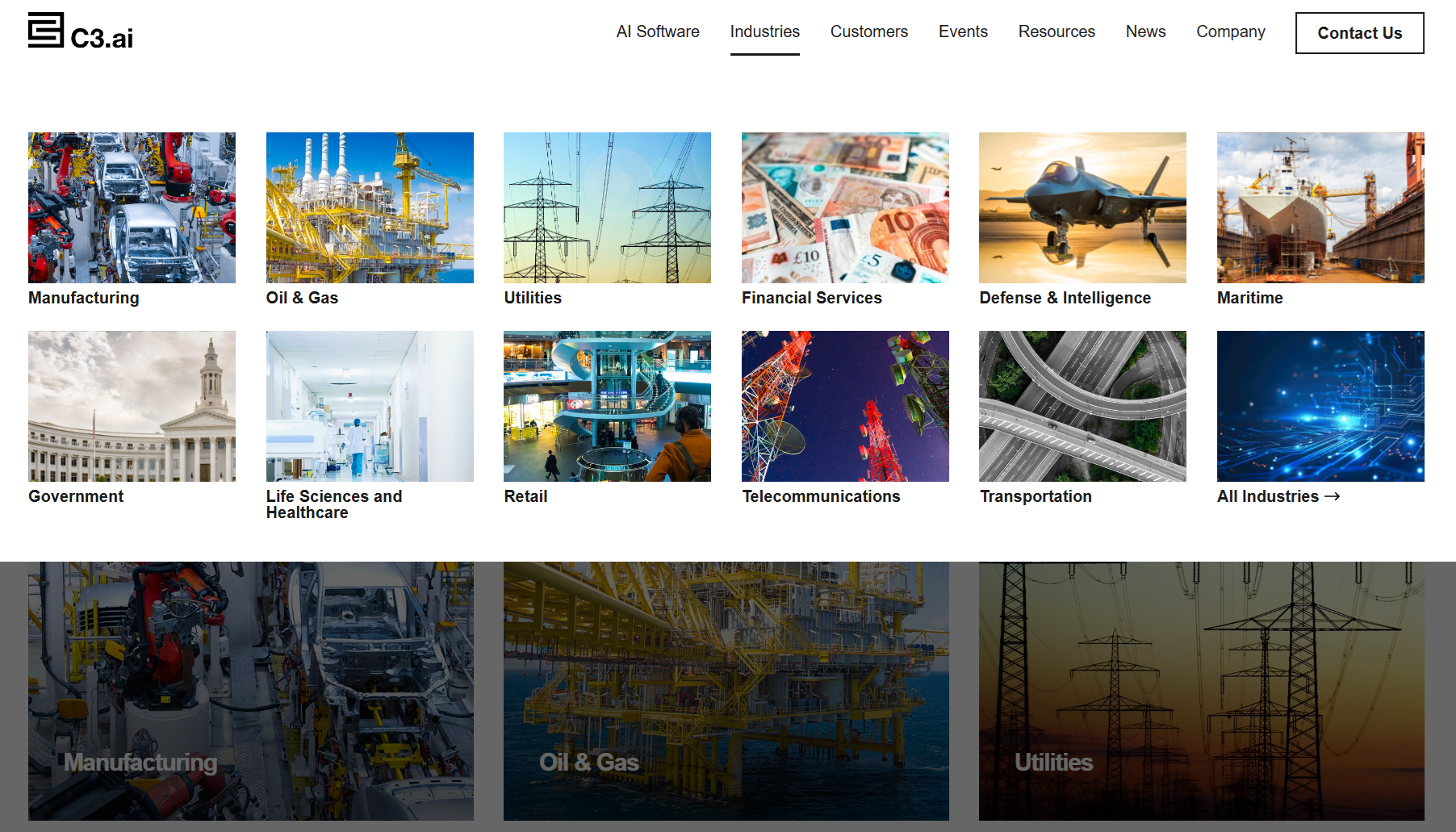
And guess what? C3 AI (ticker $AI, yea Tom is a clever guy) is trading at a market cap of $2B, less than 200 times the market cap of Palantir at $400B.
For all of the foregoing reasons – despite Palantir showing expanding commercial growth – I still main a short thesis on $PLTR.
Q1 Update dated 5/6/25
Palantir reported Q1 earnings yesterday.
On the surface everything appears exceptional.
EPS ($0.13) beat of 1.1% and revenue ($884M) beat of 2.5%.
Closed 139 deals over $1M with U.S. commercial TCV at $810B, up 183% yoy.
Rule of 40 score of 83%.
They even raised guidance to $3.9B for calendar 2025.
But something is deeply amiss with Palantir.
Watch this earnings webcast that was self-described as being “on fire” and see if you can spot what Palantir’s hamartia may be.
Preface: I was a senior sales operations manager at C3 AI – the leading competitor to Palantir in enterprise AI software. I worked on large enterprise deals directly with the the sales and management team, so understand the enterprise AI deal process and enterprise AI product offering very well. Fundamentally, C3 AI has the same business model as Palantir but with a more commercial focus rather than a government one.
So what is amiss with Palantir?
First, Palantir’s P/E is sitting at 650 while it’s P/S is at 100, making it the most expensive large cap stock ever on a revenue basis. At an almost $300 billion market cap with 34% revenue growth and less than $3B in sales for all of 2024, the stock’s valuation is completely disconnected from its fundamentals.
Here’s a table of the most overvalued large cap stocks in history, sorted by date of the peak P/S along with the P/E a year later, and the changes in revenue, EPS, and share price in the year following the peak valuation:

Nvidia
Nvidia’s valuation was deemed “insane”, but went on to deliver (and continues to) staggering growth for investors. Nvidia appeared to be a once in lifetime growth story, yet Palantir is somehow priced much higher.
Nvidia, unlike Palantir, has an almost impenetrable moat as it provides the foundation hardware layer for all of AI from agentic AI to physical AI. Palantir operates at the software layer, where there are many competitors and the barriers to entry are low.
Tesla
Tesla’s 1400 P/E in 2021 looks insane but EPS exploded the following year and the valuation normalized somewhat. Palantir doesn’t have anywhere close to that growth coming, and Karp has nowhere near the cult following that Musk does.
Cisco
Cisco is a better comparison. It crashed over 80% during the dotcom bubble pop and never returned to those levels. PLTR is more expensive with weaker growth and is somehow projected for less revenue growth than Cisco saw throughout that 80% stock decline.
Zoom
The closest comparison is Zoom, which peaked with a P/S of 106 in late 2020. Zoom went on to grow revenue at 170% and EPS at 319% over the next year. Despite that insane growth (much higher than what Palantir is projected to do), the stock still dropped 45% in that time, then bottomed nearly 90% from its highs. Palantir is trading at a similar valuation with significantly less growth. 2021 was also a euphoric market year, while we’re at the beginning of a market-wide bubble pop.
Palantir is more expensive than Zoom at its peak valuation (at the beginning of one of the most euphoric market periods we’ve ever seen) with much less projected growth. It is also trading far above Nvidia’s peak multiples despite Nvidia growing more than 6x faster on revenue and 4x faster on EPS.
Conspiracies
Palantir’s surge is driven by AI hype and retail euphoria. I saw bulls on Twitter/X calling for the stock to 10x in five years which is ridiculous. Some of the hype is also based on a weird conspiracy that Trump is going to pump it or Peter Thiel is going to enslave us all with AI. I have no idea where that comes from and I’m 99% sure that everyone blindly parroting these claims has no idea what Palantir actually does either.
True Business Model
Palantir, like C3 AI, is fundamentally a professional services IT consulting company. Think McKinsey with its analytics offering – QuantumBlack.
Yes, they sell software, but because it’s enterprise, everything has to be customized for each individual customer. It’s not a SaaS business – it’s a customized IT software development business. Their multimillion contracts are really just large IT consulting contracts, like the ones you will find at Deloitte.
They also have a huge concentration risk with the U.S. government – yes, they’re in favored with the Trump admin, but not so sure this will last past 2028. In case you didn’t know, Peter Thiel co-founded and bankrolled Palantir (hiring Karp as CEO). Thiel also hired and bankrolled J.D. Vance – this is why Palantir is getting preferential treatment with Trump.
Naive investors – both retail and institutional – have been tricked by Alex Karp into thinking Palantir has proprietary IP the main one that keeps being brought up is “ontology.” I don’t want to get into the technical details, but anyone with a computer science background will realize “ontology” is no more proprietary than “data science.”
There you have it.
Palantir is the “Gamestop” of AI this year – a meme stock whose fundamental business is more like McKinsey, than Nvidia.
Disclosure: for all of the above reasons and more, I am short PLTR.

“The superior man is aware of righteousness; the inferior man is aware of advantage.”
-The Analects of Confucius 4:16
 Jude Christensen
Leave a comment