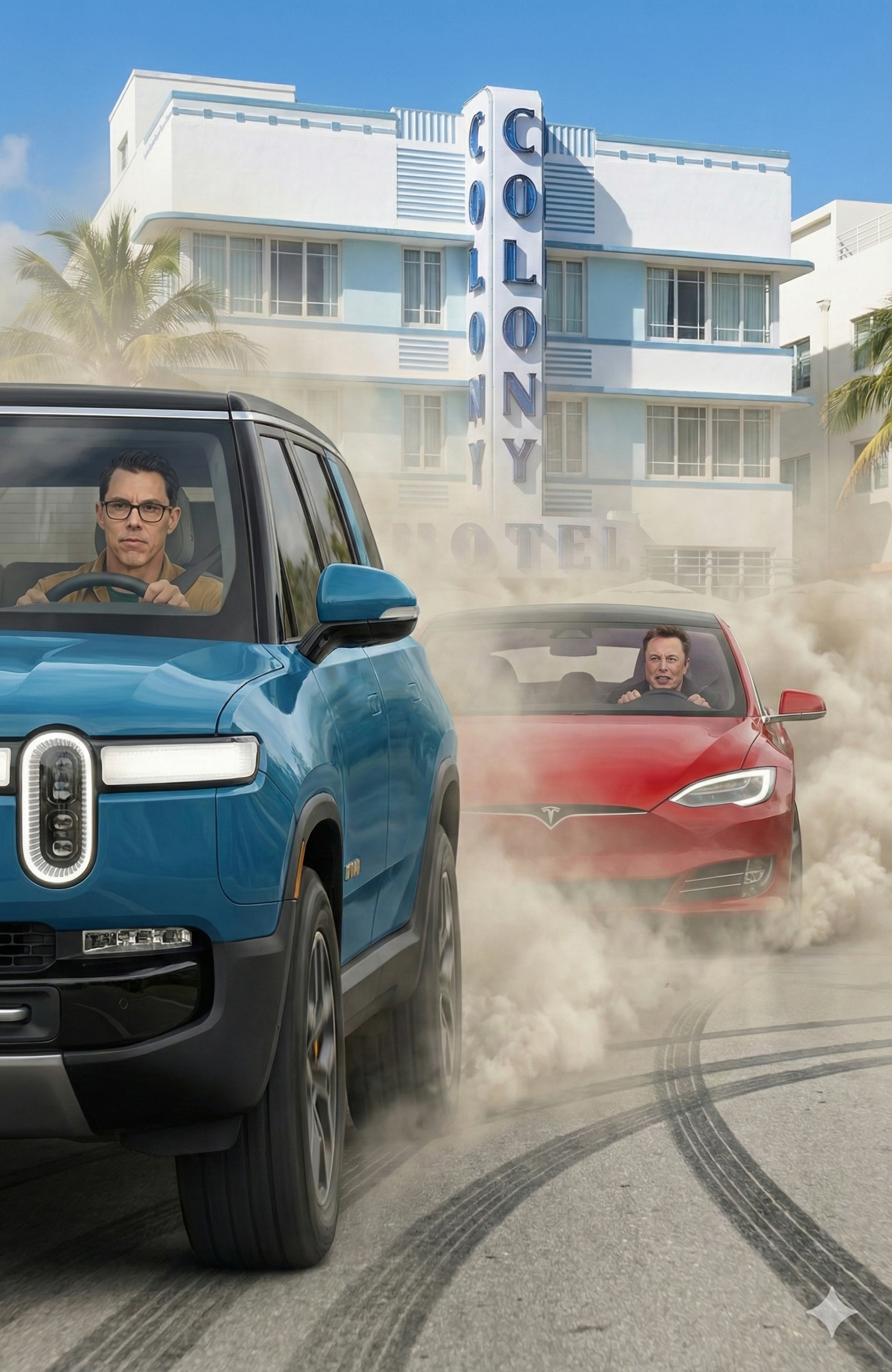
Paradoxical Insight: Tesla’s stratospheric success in scaling to millions of vehicles, and Elon Musk’s increasing involvement in right-wing politics, has fundamentally destroyed its premium and eco-conscious brand, creating a vacuum that Rivian is architected to fill.
Preface: I am trying a new format for writing my investment theses for public consumption – it will be divided into three sections:
- Investment Thesis: the main hypothesis and argument, often through the lens of science and math and fundamental valuations when it matters (the tech has near-term commercial viability.
- Risks: what are the risks that may prevent the thesis from playing out.
- Catalysts: as noted in my investment philosophy vetting the story (finding a correct non-consensus view) is only half of the game; a good chunk of the other half is the catalysts (what events will actually start the resolution of said thesis).
- Investment Implications: given our view, what is the best expression? Thinking about securities and the structured nature that options can provide in expressing the view.
As I evaluate many frontier tech (quantum computing, photonics, space-based data centers), I think this will greatly enhance the efficiency of communicating what could be tens of pages using a traditional format like an investment committee memo or an equity research report.
Investment Thesis
- Brand Exclusivity: Tesla’s Model 3 and Model Y have become the “Camry of EVs” – a utility vehicle with a deteriorating brand (largely driven by Elon Musk’s right-wing politics). In chasing volume, Tesla has overshot its original premium audience. Rivian, by contrast, maintains a “premium eco-concious” identity, which is currently delivering higher brand appeal than Tesla’s mass-market fleet.
- Operational Escape Velocity: gross profit of $24M – an improvement of $416M, but $214M is from the recognition of the Volkswagen joint-venture. A much better picture with the net cash provided by operating activities hitting positive at $26M – a strong signal that Rivian’s core business is now self-sustaining, and additional capex is being use for development of say the R2 platform.
- Software Re-Rating: With its “Autonomy and AI Day,” engineering founder RJ Scaringe has clearly echoed the future direction of Rivian. It is positioning itself as a physical AI platform for transportation. Q3 Software and Services (S&S) revenue surged 324% YoY to $416 million. Yes, the Volkswagen JV contributed $214M of this, proving that Rivian is already successfully licensing its software tech (and electrical architecture) to legacy OEMs.
- Inventory Efficiency: Rivian reduced its inventory by $610M since the beginning of 2025. Showing a surge in demand, an improvement in inventory signals they are converting raw materials into cash more efficiently – clearing the way for the next generation of growth (mid-sized R2 launch).
Tesla’s stratospheric success started from its penetration into the premium EV market (just as Uber started with premium / black taxi service), it has moved way too far down-market (a classic effect of the innovator’s dilemma) that it has become “Camry of EVs.” It has lost its appeal with eco-conscious and wealthy clientele – a market that really only Rivian has done a significantly excellent job at filling. With RJ Scaringe and his practical engineering skills and his exceptional design team, Rivian is poised to take over Tesla (including the Model X) in the premium EV market.
Risks
- R2 Execution Risk: I admit much of this entire thesis hinges on the flawless launch of the R2 platform in H1 2026. Any delay in production at the Normal, Illinois facility (moving to Social Circle, Georgia for full-scale production in 2028) would result in a material burn of Rivian’s $7.1B cash cushion.
- The “Reverse Innovator’s Dilemma”: As Rivian scales with R2, they face the same trap Tesla did: can they move from 42,284 annual deliveries (2025 production) to hundreds of thousands without destroying the “premium eco-conscious” appeal that defines their brand?
- Macro and Policy Headwinds: Management explicitly cited uncertainty regarding trade, tariffs, and regulatory policy in the Q3 shareholder letter. A shift in EV tax credits or new import tariffs on components could compress the margins we’ve modeled.
Catalysts
- R2 Production and Delivery Launch: This is the primary catalyst in H1 2026. Successful first deliveries will prove Rivian can produce a $45,000 mass-market vehicle (R2 base price) at scale.
- Georgia Plant Vertical Construction: Vertical construction at the Social Circle, Georgia facility is set to begin in 2026 – which will serve as a the master plant for its R2 and R3 platform. This adds 400,000 units of long-term annual capacity, signaling to the market that Rivian is ready for the global automotive stage.
- Autonomy Optionality: Following the December 2025 Autonomy Day, we expect 2026 to see the first material revenue from Mind Robotics and expanded software licensing through the Volkswagen JV and other legacy OEMs. Of note, if Mind Robotics and its AI/autonomous initiatives succeed, we could see a spin-off that ends up being valued even higher than $RIVN itself – with a tech stack and design philosophy that’s optimized for Rivian vehicles before anyone else (a vertical physical AI stack).
Investment Implications
Going forward, I will break this section into three categories based on conviction.
1. Strong: while deep OTM calls (long-dated) may not be 100% foolish, I’d advise against it due to the high IV and the choppy behavior common among these EV/robotics/AI plays. LEAPS (delta 0.8-0.9) or debit call spreads probably the best option to minimize theta bleed and get a clean, levered expression.
2. Moderate: 70/30 or even 60/40 stock/option (LEAPS or debit call spreads) is probably cleanest expression for this conviction level. I am sitting at 50/50 personally.
3. Weak: 100% stock, maybe starting position of 5% and DCA on fallbacks to 10%. In general, I don’t add anything below 5% unless it’s a hedge of a highly levered play (deep OTM options).
I wouldn’t get fancy with collars (to limit left-tail exposure) or covered calls (harvest volatility) with this name – keep it simple and long (levered if appropriate).
 Jude Christensen
Leave a comment