Thesis: AI is moving from a computation bottleneck to a communication bottleneck. In AI factories, networking becomes part of the compute fabric. We express that shift through COHR and LITE in lasers and optical components, and MRVL in high-speed DSP/SerDes silicon. The basket is designed to own the scarce, high-barrier enabling layers, not the entire optical-networking chain. This positioning is aligned with co-packaged optics and NVIDIA’s internal photonics efforts: CPO does not remove the need for lasers, optical components, or high-speed signal-processing silicon; it pulls them closer to the ASIC and makes their performance more critical.
Review of Latest Earnings
Coherent is the broad photonics platform anchor of the basket. Q3 FY26 revenue grew 27% year over year on a pro forma basis to $1.8B, with datacenter and communications now representing 75% of revenue and growing 41% year over year. The key read-through is that Coherent is scaling the physical optical supply chain required for AI datacenters: internal InP output is on track to double by year-end and more than double again by 2027, while its 6-inch platform produces EMLs, CW lasers, and photodiodes at higher yields than legacy 3-inch lines. The company is positioned across both current optical architectures and the next phase of CPO/NPO, optical circuit switching, and multi-rail transport, making COHR the broadest public-market expression of the AI photonics bottleneck.
Lumentum is the laser and CPO torque layer of the basket. Q3 FY26 revenue grew roughly 90% year over year to $808M, driven by cloud and AI demand, while non-GAAP operating margin expanded to 32.2%. The key read-through is not simply transceiver growth, but component scarcity: record 100G and 200G EML shipments, more than 120% growth in narrow-linewidth DCI lasers, 80% growth in pump lasers for scale-across and subsea applications, and continued progress in ultra-high-power lasers for CPO. LITE remains one of the cleanest public-market expressions of the laser bottleneck, though position sizing should reflect the magnitude of the stock’s rerating.
Marvell is the signal-processing layer of the photonics basket. Q1 FY27 revenue grew 28% year over year to $2.418B, with data center revenue reaching a record $1.833B. More importantly, management tied the outlook directly to AI optical networking: 800G PAM4 demand remains strong, 1.6T is ramping quickly in scale-out, TIA/driver revenue is expected to exceed a $1B annualized run-rate, and interconnect revenue is expected to grow more than 70% in FY27. MRVL is not the purest photonics exposure, but it controls one of the highest-barrier layers: the high-speed silicon required to make distributed AI communication work.
Why These Are the Bottlenecks
The earnings data confirms demand, but the investment case rests on control of the scarce layers. The highest-value layers in AI photonics are not generic fiber or standalone pluggable transceivers. They are the components that determine whether optical communication can scale with enough bandwidth, power efficiency, and reliability to support distributed AI infrastructure. In an AI factory, the bottleneck sits around the accelerator complex and network fabric, not in the compute core itself.
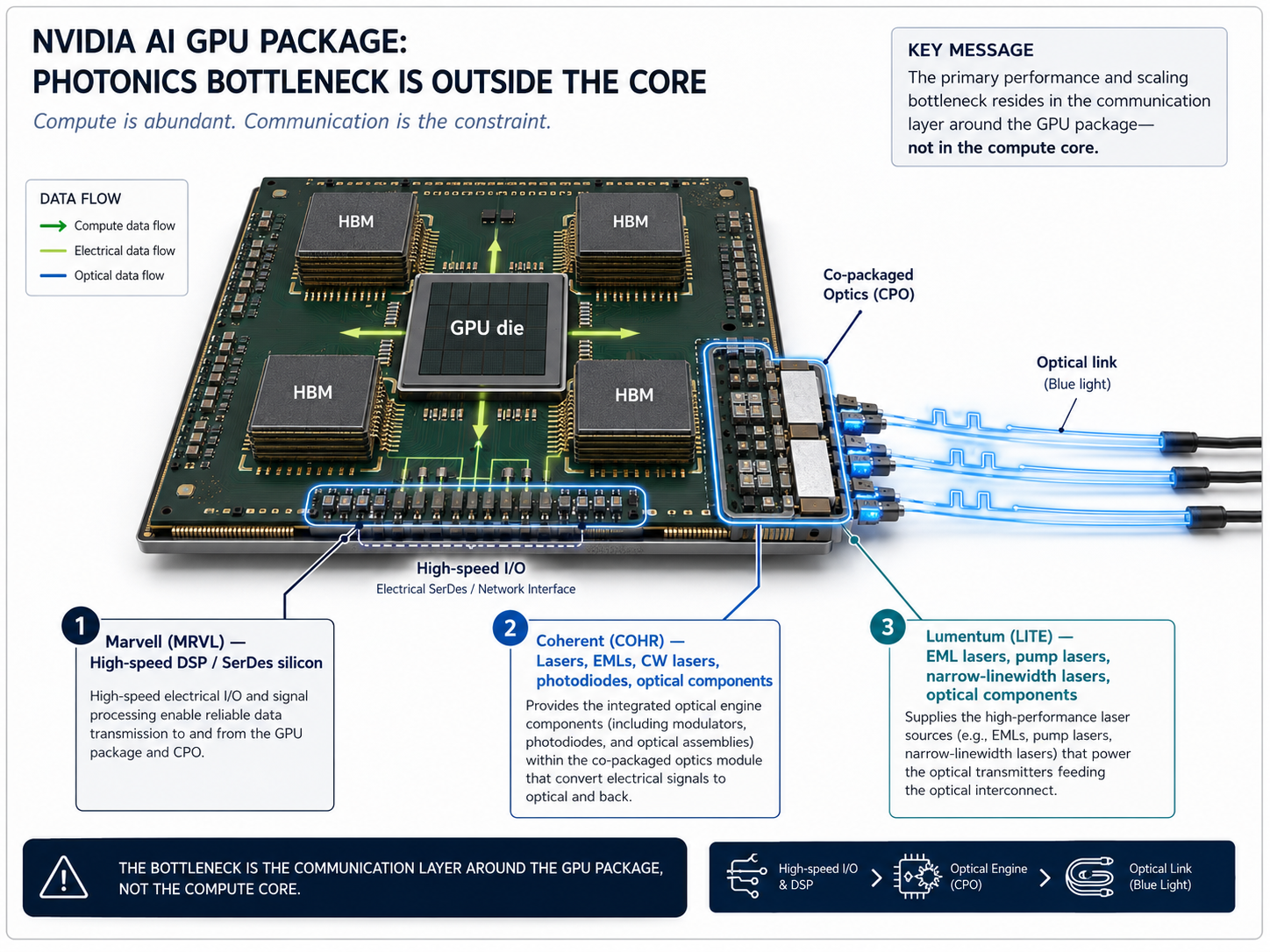
That points to three scarce layers: lasers, optical components, and high-speed DSP/SerDes silicon. COHR and LITE sit at the optical component and laser layer. MRVL sits at the DSP/SerDes layer. These are areas where physics, manufacturing yield, qualification cycles, and customer trust create real barriers to entry. This is why the basket is concentrated. It is not designed to own every company that benefits from optical networking; it is designed to own the layers where engineering difficulty becomes economic power.
Moat Analysis
The common feature across COHR, LITE, and MRVL is that each sits at a layer where scale alone is not enough. Capital matters, but it does not instantly create process knowledge, reliability data, customer qualification, or high-yield manufacturing capability.
Coherent has the broadest vertical exposure across the optical stack: materials, InP manufacturing, EMLs, CW lasers, photodiodes, transceivers, silicon photonics, CPO/NPO, and datacenter optical systems. Its moat is the combination of platform breadth, vertical integration, and manufacturing scale.
Lumentum has the cleanest exposure to the laser bottleneck. Its strength in EMLs, DCI lasers, pump lasers, ultra-high-power lasers, and optical circuit switching gives it direct leverage to the optical layers that become more critical as AI networks scale.
Marvell owns the high-speed signal-processing and connectivity silicon layer. DSP/SerDes silicon is one of the hardest parts of the stack to replicate because performance depends on mixed-signal design, signal integrity, power efficiency, software/firmware, and deep customer integration.
The result is a concentrated basket across three durable control points: Coherent’s optical platform breadth, Lumentum’s laser and CPO exposure, and Marvell’s high-speed signal-processing silicon.
NVDA and CPO Strengthen Thesis
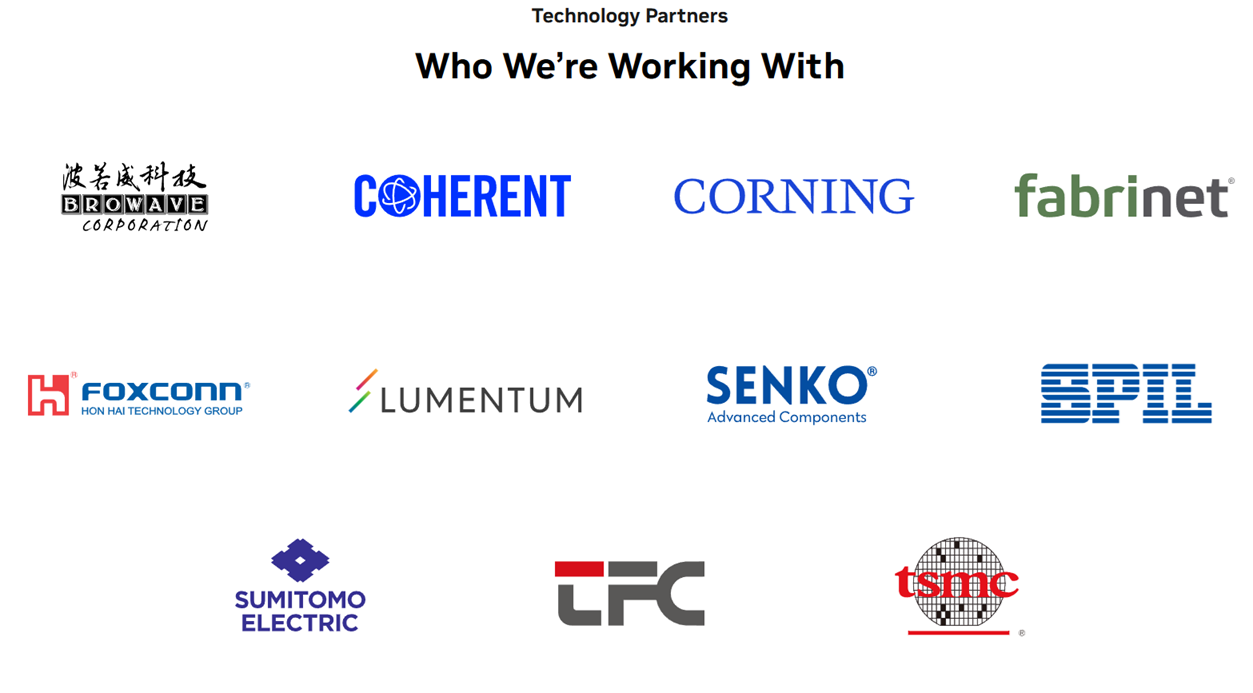
A natural objection is that NVIDIA may internalize more of the photonics stack. We view that risk differently. NVIDIA’s push into silicon photonics validates the bottleneck rather than eliminating suppliers, as evidenced by its partnerships and $2 billion strategic investments in each of Coherent and Lumentum.
Co-packaged optics does not remove the need for lasers, optical components, or high-speed signal-processing silicon. It moves those functions closer to the ASIC, where power, thermal behavior, reliability, and signal integrity become more demanding. The closer optics move to the heart of the system, the higher the penalty for failure.
NVIDIA can architect the AI factory, but it still needs qualified suppliers capable of delivering critical optical building blocks at scale. As CPO shifts more of the optical interface closer to the ASIC, value migrates from the standalone pluggable form factor toward the components that survive across architectures: light sources, optical engines, photonic devices, and high-speed silicon.
This is why the basket is structured around enabling components rather than legacy form factors. We are not betting on the persistence of the old transceiver architecture; we are betting on the lasers, optical components, and high-speed silicon that become more important as the architecture evolves.
Why We Exclude the Rest
The exclusion of other photonics-related companies is intentional. We are not trying to own every beneficiary of AI optical networking; we are trying to own the scarce layers where technical difficulty is most likely to become durable earnings power.
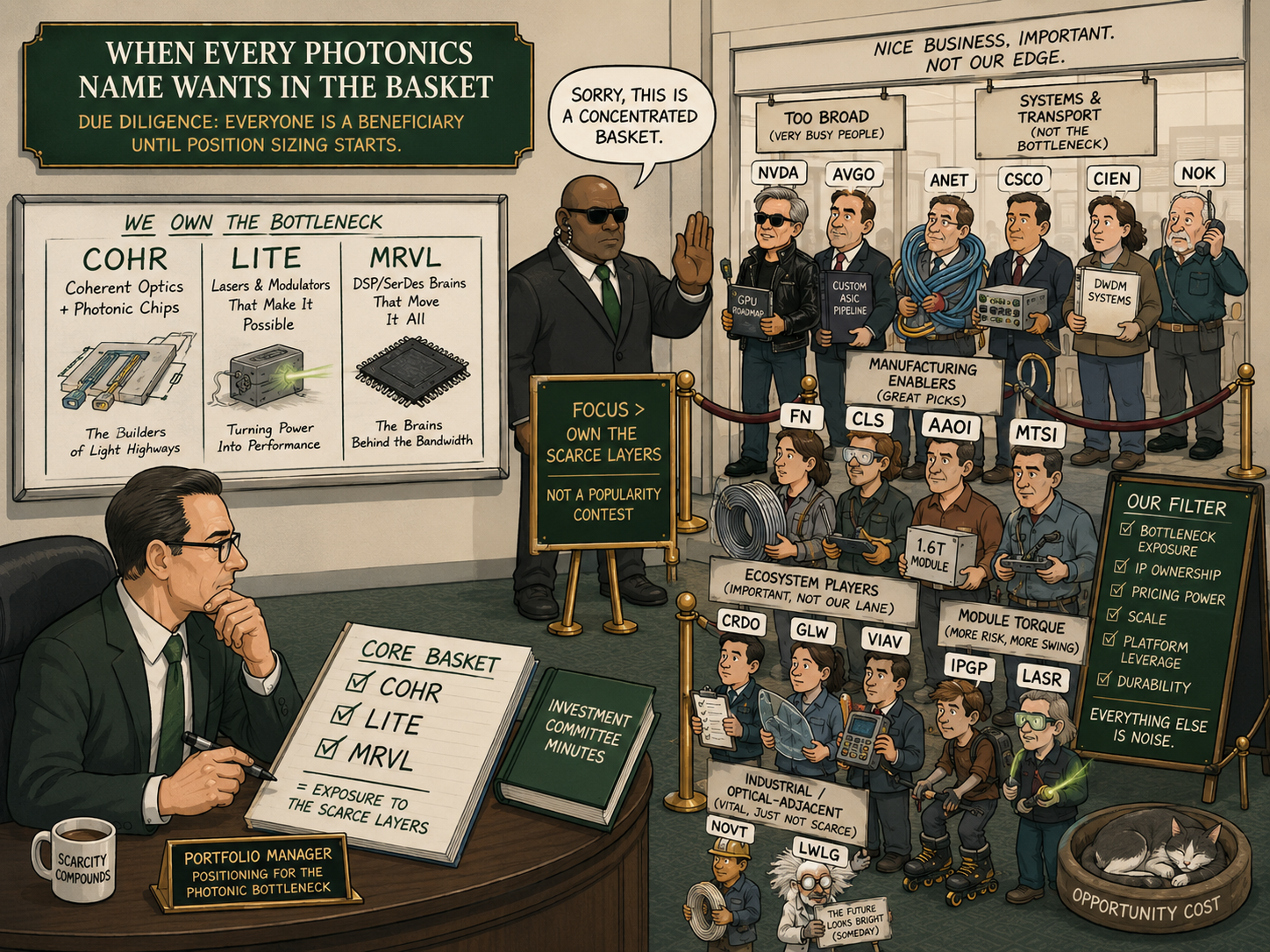
NVIDIA (NVDA), Broadcom (AVGO), and Arista (ANET) are high-quality AI infrastructure winners, but photonics is diluted inside broader GPU, software, switching, ASIC, and networking platform stories.
Cisco (CSCO), Ciena (CIEN), and Nokia (NOK) are important optical systems, transport, and DCI players, but they are more exposed to network architecture than to the component bottlenecks we are targeting.
Fabrinet (FN) and Celestica (CLS) are strong manufacturing and integration enablers, but their moats are operational rather than proprietary.
Applied Optoelectronics (AAOI) offers direct 1.6T transceiver torque, but with greater customer concentration, pricing, and module-cycle risk.
MACOM (MTSI) and Credo (CRDO) are credible high-speed connectivity beneficiaries, but we prefer the broader optical platform exposure of Coherent and Lumentum, and the DSP scale of Marvell.
Corning (GLW) and Viavi (VIAV) are necessary ecosystem players in fiber/glass and test/measurement, but less direct bottleneck owners.
IPG Photonics (IPGP), nLIGHT (LASR), and Novanta (NOVT) have real photonics or laser exposure, but their businesses are primarily industrial, medical, scientific, or manufacturing-driven rather than directly tied to AI datacenter optical interconnect.
Lightwave Logic (LWLG) is more directly relevant to silicon photonics through electro-optic polymer modulators for 800G and 1.6T platforms, but remains less proven commercially and does not yet belong in a concentrated institutional basket.
The goal is not to dismiss these companies. It is to isolate the cleanest public-market expression of the AI photonics bottleneck: COHR for optical platform breadth, LITE for laser and CPO exposure, and MRVL for high-speed DSP/SerDes silicon.
Portfolio Construction
We acknowledge the significant rerating across these names and the broader photonics complex. The move has been justified by the acceleration in AI optical demand, but it also raises the bar for forward returns. We believe the basket remains attractive because the market may still underestimate the duration and magnitude of the optical networking upgrade cycle. The proposed basket is intentionally concentrated:
| Company | Ticker | Target | Exposure | YTD (6/21/26) |
| Coherent | COHR | 40% | Broad platform | 111% |
| Marvell | MRVL | 35% | DSP/SerDes | 265% |
| Lumentum | LITE | 25% | Laser & CPO | 152% |
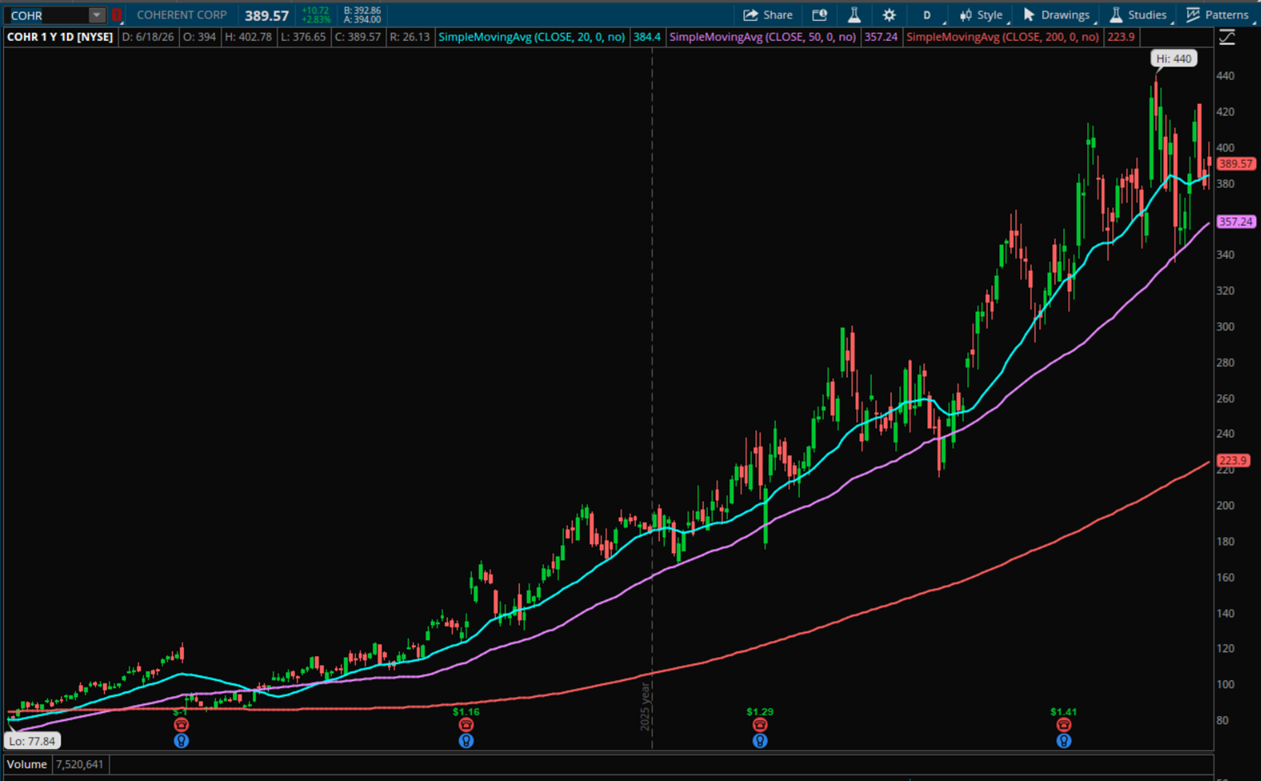
COHR receives the largest allocation because it offers the broadest direct exposure to the AI optical layer. It is not dependent on one implementation path; it participates across materials, components, transceivers, silicon photonics, CPO/NPO, and optical systems. The 40% weight reflects Coherent’s platform breadth, manufacturing scale, technical position, and prospective return profile.
From a technical and entry perspective, COHR remains in a strong uptrend, trading above its 20-day, 50-day, and 200-day moving averages after a 373% one-year move and 111% YTD gain. The stock has pulled back roughly 12% from its recent high, while an RSI near 53 suggests the near-term setup is no longer extended. For investors underwriting the long-term photonics thesis, incremental weakness could provide an attractive opportunity to build exposure.
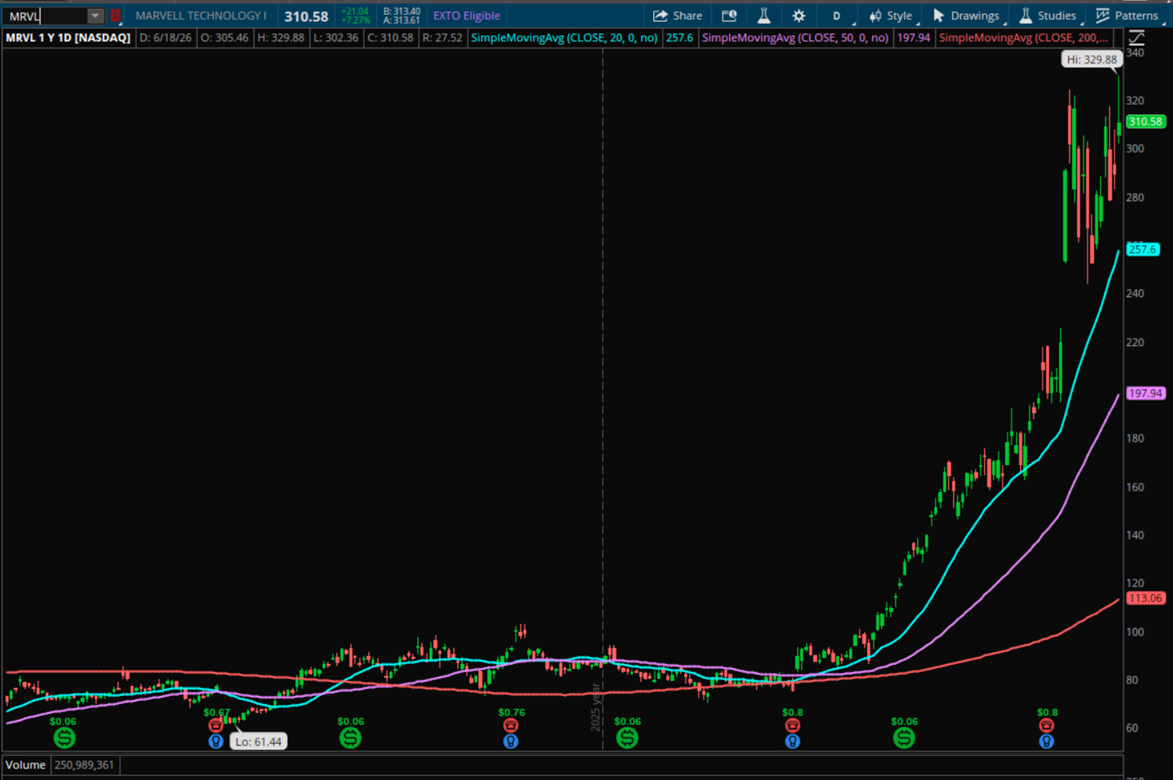
MRVL receives a large allocation because DSP/SerDes is one of the highest-barrier parts of the stack. Its weight is capped below COHR because Marvell is less pure, with exposure to custom silicon, switching, storage, and broader datacenter semiconductors. Even after a 265% YTD move, Marvell remains one of the cleanest large-scale public expressions of the high-speed signal-processing silicon required for AI optical networking.
From a technical and entry perspective, MRVL remains significantly extended, trading well above its 20-day, 50-day, and 200-day moving averages and only modestly below its recent high. With earnings approaching, the risk/reward may be better on a pullback rather than after a sharp sentiment-driven move. A retracement toward prior support or the low-200s would represent a more attractive entry point for investors seeking to build exposure without chasing momentum.
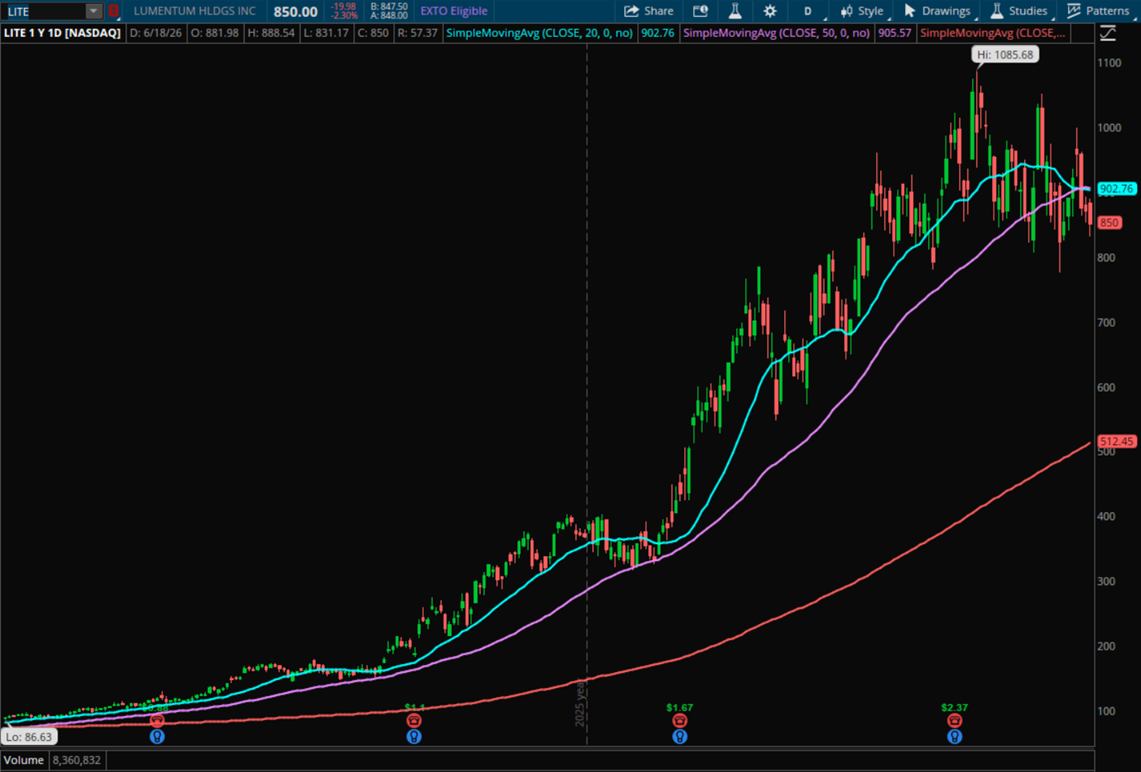
LITE remains essential because it is one of the cleanest expressions of the laser bottleneck and CPO transition. Its weight reflects both the quality of the exposure and the magnitude of the stock’s rerating. With a one-year return of roughly 860%, a 25% allocation is already substantial, but it is justified by Lumentum’s direct leverage to high-quality lasers, optical components, and CPO.
From a technical and entry perspective, LITE has the least attractive near-term setup of the three. Momentum has weakened, the RSI is near 46, and the 20-day moving average has crossed below the 50-day moving average, even though the stock remains well above its 200-day moving average. Given the magnitude of the prior move and the softer near-term trend, it may be prudent to wait for either a clearer technical reset or the next earnings update before adding aggressively.
This concentrated basket is a 65% direct photonics platform and optical component exposure through COHR and LITE, with 35% high-barrier signal-processing silicon exposure through MRVL.
What Could Break the Thesis
1. Copper and pluggables last longer than expected
Active electrical cables, retimers, improved switching architectures, and continued pluggable innovation may extend the life of existing interconnect approaches.
2. Transceiver and component economics compress
Even if optical demand grows, pricing could fall quickly, especially if capacity expands faster than demand.
3. CPO adoption is slower than expected
Reliability, serviceability, thermal management, and ecosystem readiness could delay adoption.
4. Customers capture more of the value
NVIDIA, hyperscalers, and large OEMs can shift programs, dual-source suppliers, internalize more of the stack, or pressure margins.
5. Supply catches up
If suppliers build capacity ahead of demand, today’s scarcity economics may normalize.
6. The stocks already discount the inflection
The market may already be pricing in a large part of the earnings acceleration, leaving less room for forward returns.
The Optical Toll Roads
The AI inversion began with software abundance pushing scarcity into the physical world: chips, power, cooling, land, packaging, and infrastructure. The photonics thesis extends that logic. As AI systems scale from individual accelerators into distributed AI networks, the limiting resource becomes not only computation, but the ability to move information across the unified computational system.
That is why this photonics basket is intentionally concentrated. We are not trying to own every company exposed to optical networking. We are trying to own the layers where the separation of computation and communication becomes economically measurable: optical platform breadth at COHR, laser and CPO exposure at LITE, and high-speed DSP/SerDes silicon at MRVL.
The thesis does not require every pluggable transceiver to disappear or every network to become fully co-packaged overnight. It requires only that AI scale continues to make communication more valuable, more power-sensitive, and more technically demanding. In that world, the durable value should accrue to the suppliers that control the components required to convert distributed intelligence from an abstract software capability into physical infrastructure.
If AI is becoming a distributed system, the optical layer becomes the toll road. This basket owns the companies closest to collecting that toll.


Leave a Reply