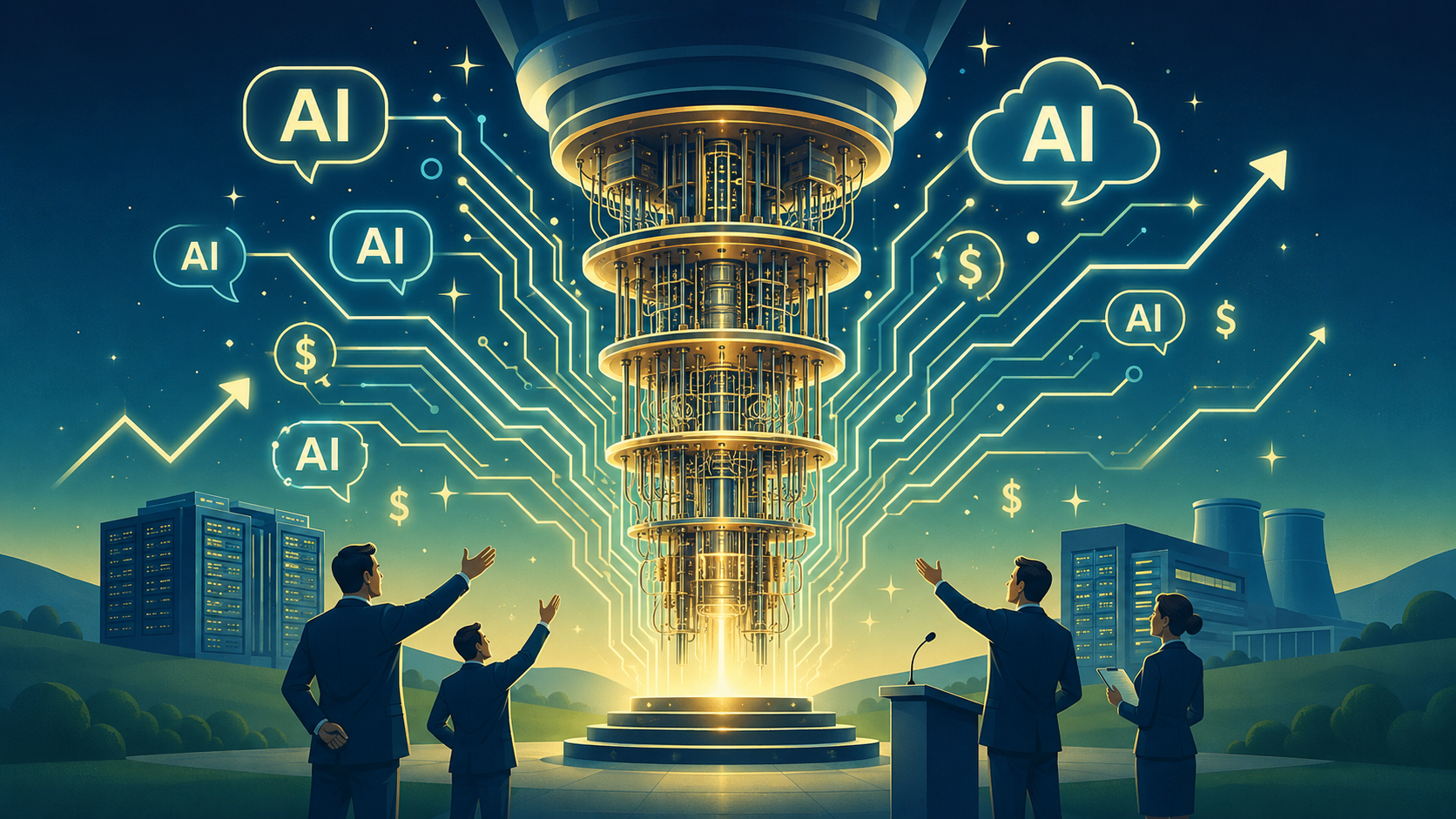
Paradoxical Truth: The market assumes quantum computing will matter because it accelerates AI, but the deeper truth may be the opposite: quantum’s value is likely in quantum-native problems that AI and classical computers struggle to model directly. Frontier AI architectures – from LLMs to multimodal and world models – run on dense, parallel, classical computation that GPUs and AI accelerators already handle extremely well. Quantum computers add significant complexity without clearly improving these workloads. The real opportunity is not “Quantum AI,” but quantum-native computation in chemistry, materials, cryptography, and scientific discovery.
AI is Highly Parallelizable on Classical Computers
The first problem with “Quantum AI” is that modern AI is not waiting for a new physics of computation. Today’s frontier AI architectures – from LLMs to multimodal and world models – are built on dense, parallel, classical computation. Their core operations are matrix multiplications, attention calculations, activation functions, normalization layers, and memory movement. These are not quantum-native workloads. They are classical numerical operations that can be divided into millions of smaller calculations and executed simultaneously.
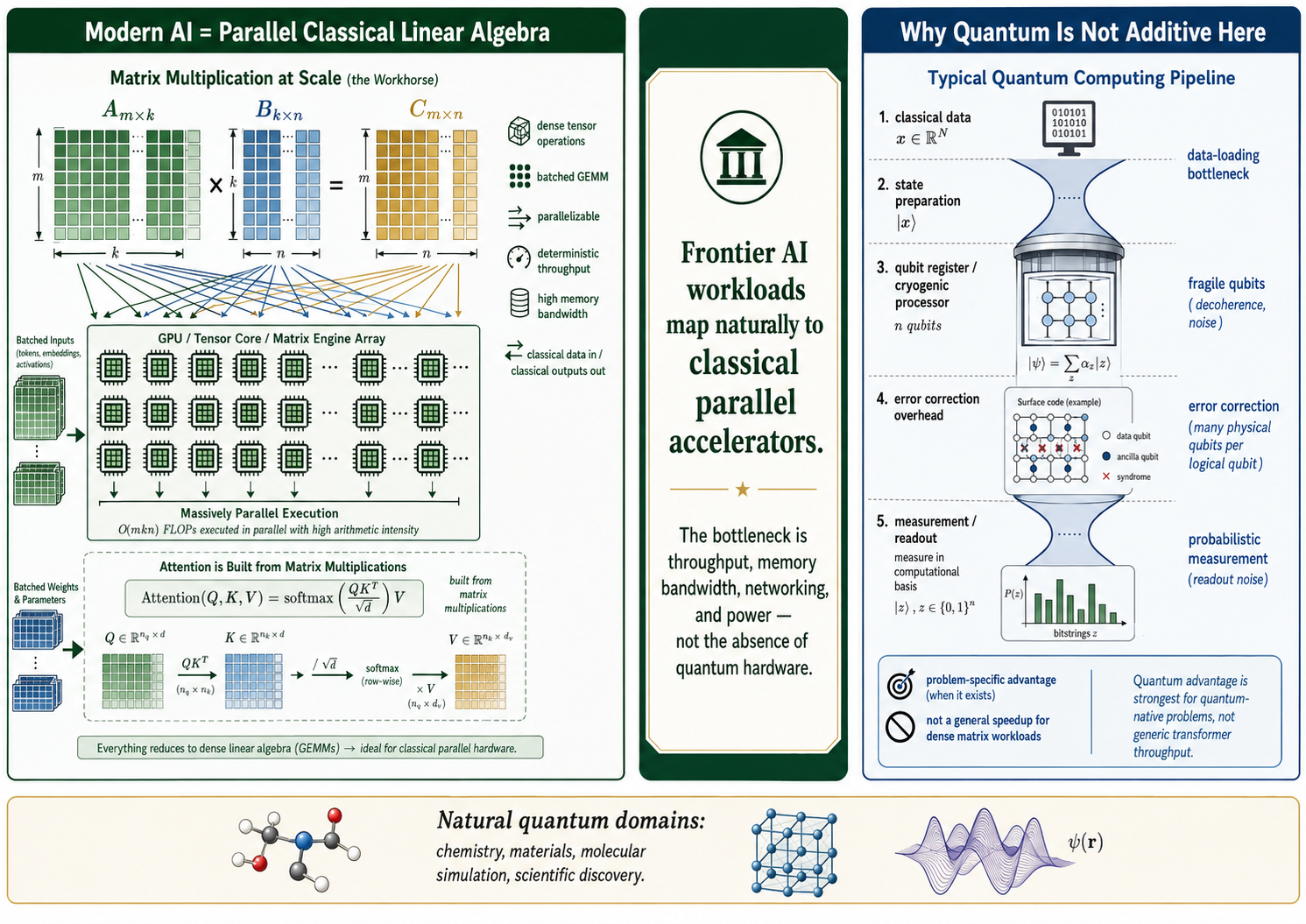
This is precisely why GPUs and AI accelerators became the foundation of the AI era. GPUs were originally designed to render graphics by performing many similar mathematical operations in parallel. Deep learning discovered the same hardware advantage. Neural networks, and especially transformers, map extremely well onto this architecture. The transformer did not expose the weakness of classical computing. It exploited one of classical computing’s greatest strengths: massive parallel throughput.
That is the key distinction. AI’s bottleneck is not that classical computers cannot perform the underlying math. The bottleneck is scale: more parameters, more tokens, more data, more memory bandwidth, more networking, more power, and more data-center coordination. AI does not need a more exotic computer; it needs more throughput. Quantum computing does not clearly solve these constraints.
Quantum Advantage is Problem-Specific
The deeper issue is that quantum computing is not a general-purpose acceleration layer for classical workloads such as AI training and inference. Quantum computers do not simply perform the same operations as GPUs at higher speed. They use a different computational model – qubits, unitary transformations, interference, entanglement, and measurement – that can be powerful only when the structure of the problem allows a quantum algorithm to exploit it.
This matters for AI because today’s frontier models are built from classical data and classical numerical operations. Text, images, video, code, embeddings, weights, activations, and gradients live in classical memory. GPUs operate directly on this data. Quantum computers generally do not. To use a quantum computer for an AI workload, the data must be encoded into quantum states, processed, and measured back into classical outputs.
That input/output step is not a minor implementation detail. It is often where theoretical quantum speedups become commercially fragile. A narrow algorithmic advantage is not enough if the full system must pay large costs in state preparation, readout, noise, error correction, and integration with classical infrastructure. For AI, where the bottleneck is already data movement, memory bandwidth, and throughput, quantum computing risks adding another layer of complexity rather than removing one.
This is why “Quantum AI” claims often sound stronger at the algorithm level than at the architecture level. The relevant question is not whether quantum computing can be powerful. It is whether it improves the end-to-end AI workload better than classical accelerators already optimized for dense tensor computation. Today, that case has not been demonstrated.
Where Quantum Actually Fits
This does not mean quantum computing is unimportant – it has tremendous scientific potential. It means the market may be assigning quantum computing a role in the AI infrastructure buildout that it may not naturally deserve.
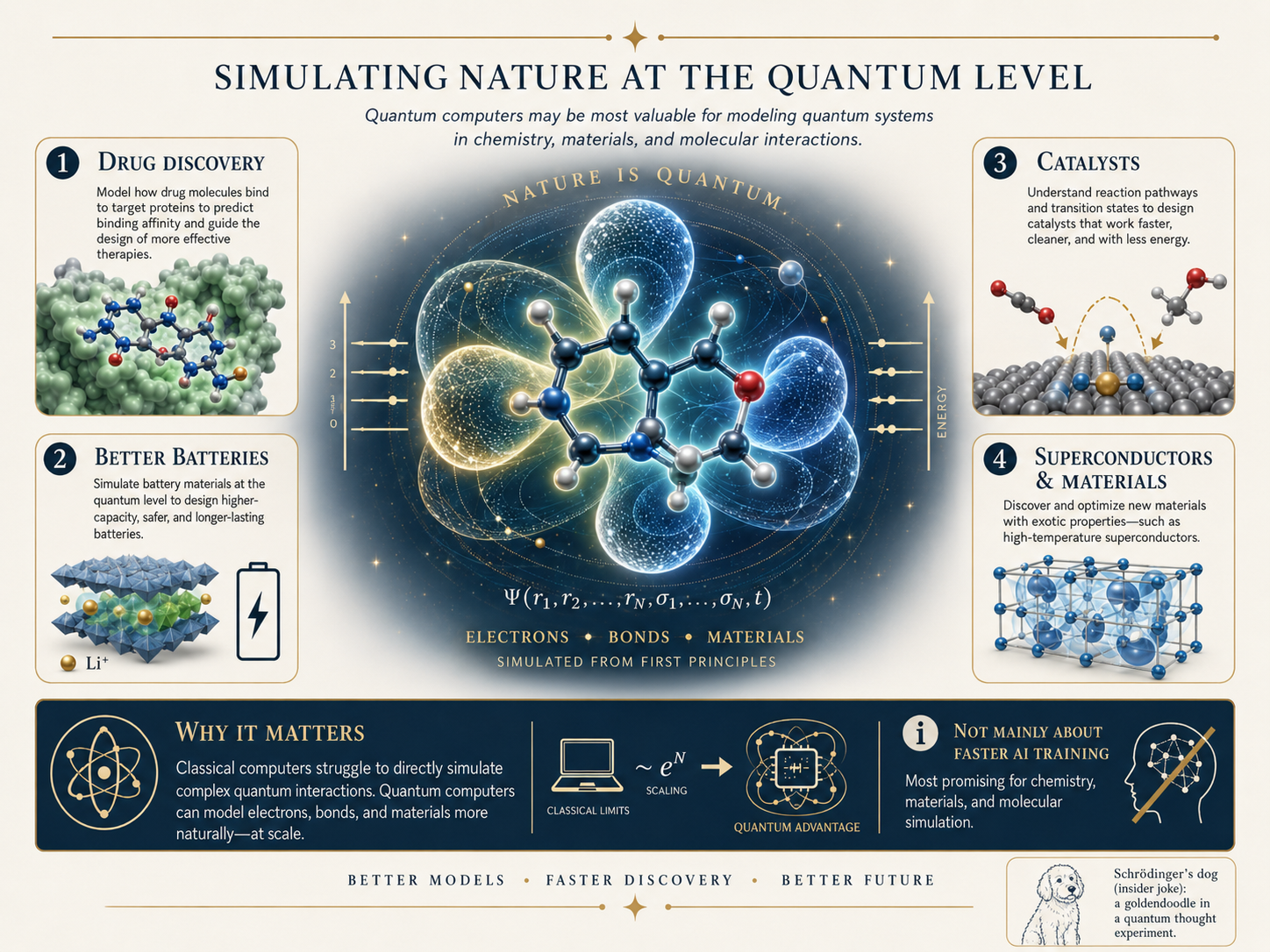
Quantum computers are likely most valuable where the system being modeled is itself quantum mechanical. Chemistry, materials science, catalysts, batteries, superconductors, electronic structure, reaction energetics, and molecular simulation are more natural fits than AI training. In these domains, classical computers can approximate many systems, but they struggle as the number of interacting quantum states grows.
This distinction also clarifies the role of AI in scientific discovery. AI can be extremely useful for prediction, pattern recognition, and model generation, as systems like AlphaFold have shown for protein folding. But that does not mean quantum computers become natural AI accelerators. If anything, it reinforces the opposite point: AI can advance many scientific workflows on classical hardware, while quantum computing must prove it adds value where classical AI and classical simulation face structural limits.
That is the better framing. Quantum computing may not be the next AI accelerator. It may be a specialized scientific computing platform.
“Quantum AI” implies that quantum computers should accelerate the current AI stack. “Quantum-native computation” implies something different: using quantum machines for problems where classical machines face physical or mathematical limits. AI is a classical data-processing problem built on parallel computation. Quantum computing is a specialized architecture for quantum-structured problems. Both may matter, but they are not the same platform shift.
If a quantum company is being marketed as an AI infrastructure beneficiary, the burden of proof should be simple: the quantum tech needs to show that it can improve the end-to-end AI workload better than classical accelerators already optimized for AI tensor computation.


Leave a Reply