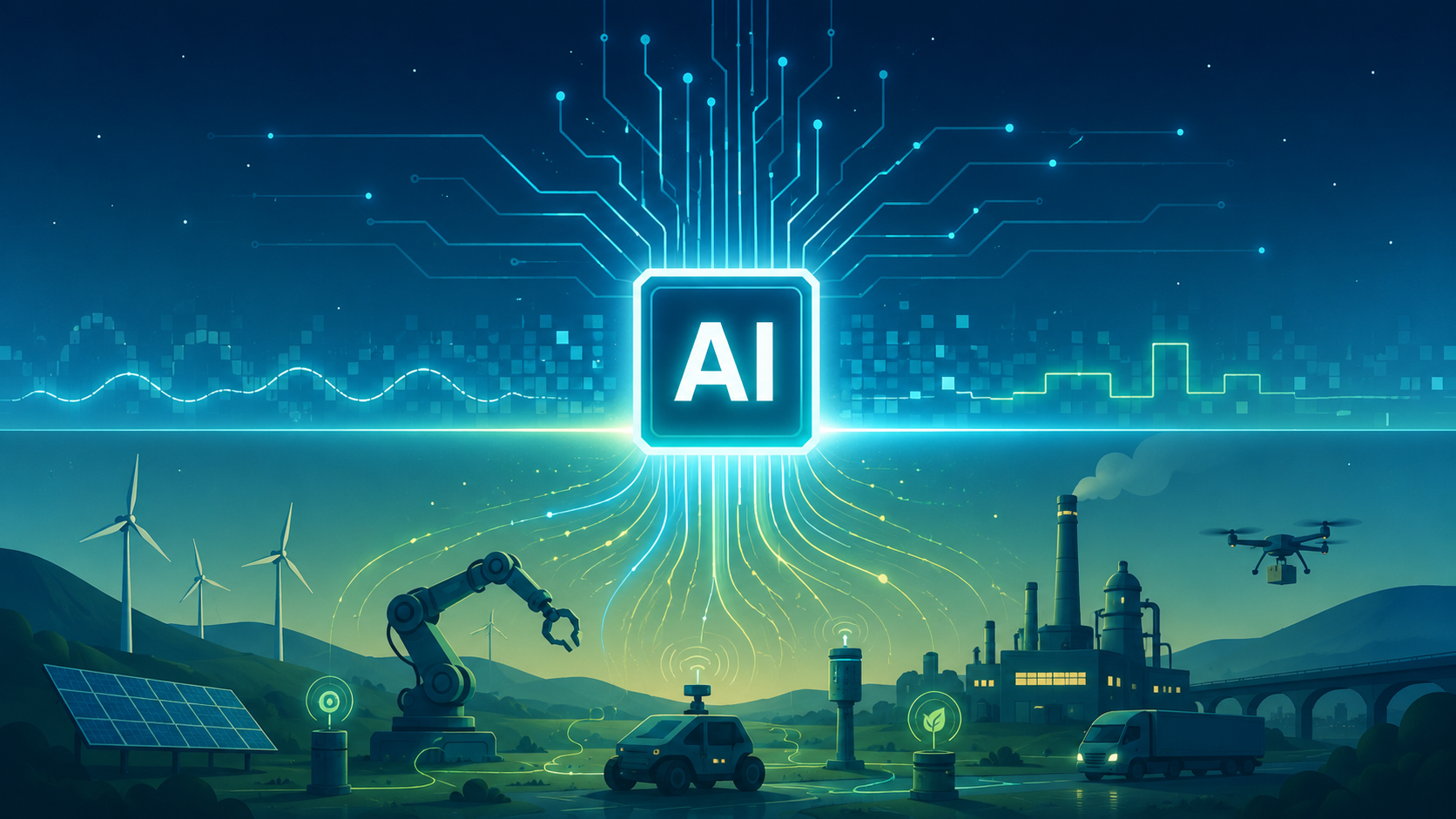
Paradoxical Truth: The market assumes Physical AI will be won by better robot brains, larger models, and more GPUs. We believe the more investible bottleneck may sit one layer lower: the analog-digital boundary that allows intelligence to enter the physical world. As AI moves from generating tokens to controlling machines, the scarce resource becomes the ability to reliably sense, measure, and control physical systems – conditioning messy real-world analog signals, converting them into digital inputs, and turning digital decisions back into physical action. These are not commodity functions. They require scarce analog engineering talent, long product qualification cycles, and decades of accumulated design knowledge. If AI is moving from tokens to machines, then the companies that own the sense-measure-control layer may become the quiet toll roads of Physical AI.
AI is Moving From Data to Reality
The first wave of the AI super-cycle was largely digital. Models operated on information that had already been converted into data: text, documents, code, images and videos. The hard work of converting reality into data had already happened before the model ever saw the input. Physical AI changes that architecture. A robot, autonomous vehicle, drone, factory machine, battery system, medical device, or energy system does not begin with clean digital abstractions. It begins with physical phenomena: light, sound, pressure, current, voltage, temperature, acceleration, torque, vibration, and motion.
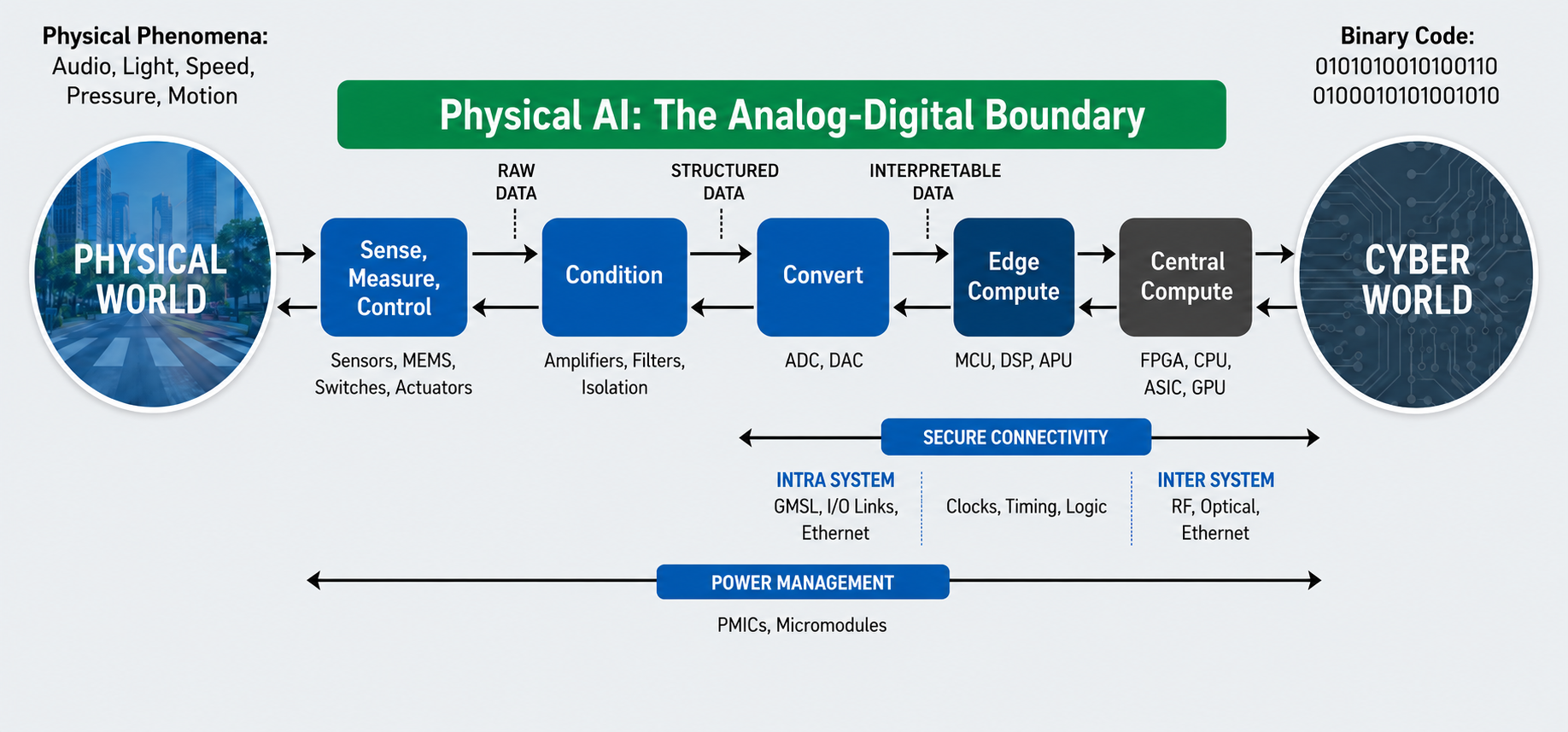
That shift changes the bottleneck. Digital AI turns data into intelligence. Physical AI must first turn reality into data, then turn intelligence back into action. With Physical AI, the scarce layer is the analog-digital boundary: the mixed-signal circuitry that allows machines to sense, measure, condition, convert, power, isolate, connect, and control physical systems. This is where continuous, noisy, real-world signals are preserved, cleaned, translated, and synchronized before they become machine-readable digital inputs. A model can only reason from the signal it receives; it cannot recover information lost to noise, poor conditioning, timing errors, power constraints, or thermal drift. Physical AI is therefore not merely a sensor problem or a compute problem. It is the interface layer where messy analog reality becomes trusted digital intelligence.
Why the Bottleneck Matters Now
Physical AI matters now because AI is beginning to leave the screen. Full self-driving or FSD is the most visible example. A vehicle is not a language model on wheels; it is a real-time physical intelligence system that must interpret cameras, radar, inertial motion, road geometry, lighting, weather, surrounding vehicles, pedestrians, battery state, and control feedback, then convert digital decisions into steering, braking, acceleration, and motion. Robotics is the broader version of the same shift. A warehouse robot, factory robot, surgical robot, humanoid robot, or autonomous mobile robot must know where it is, what it is touching, how much force it is applying, whether a motor is drifting, whether a sensor is noisy, whether a battery is overheating, and whether the environment has changed.
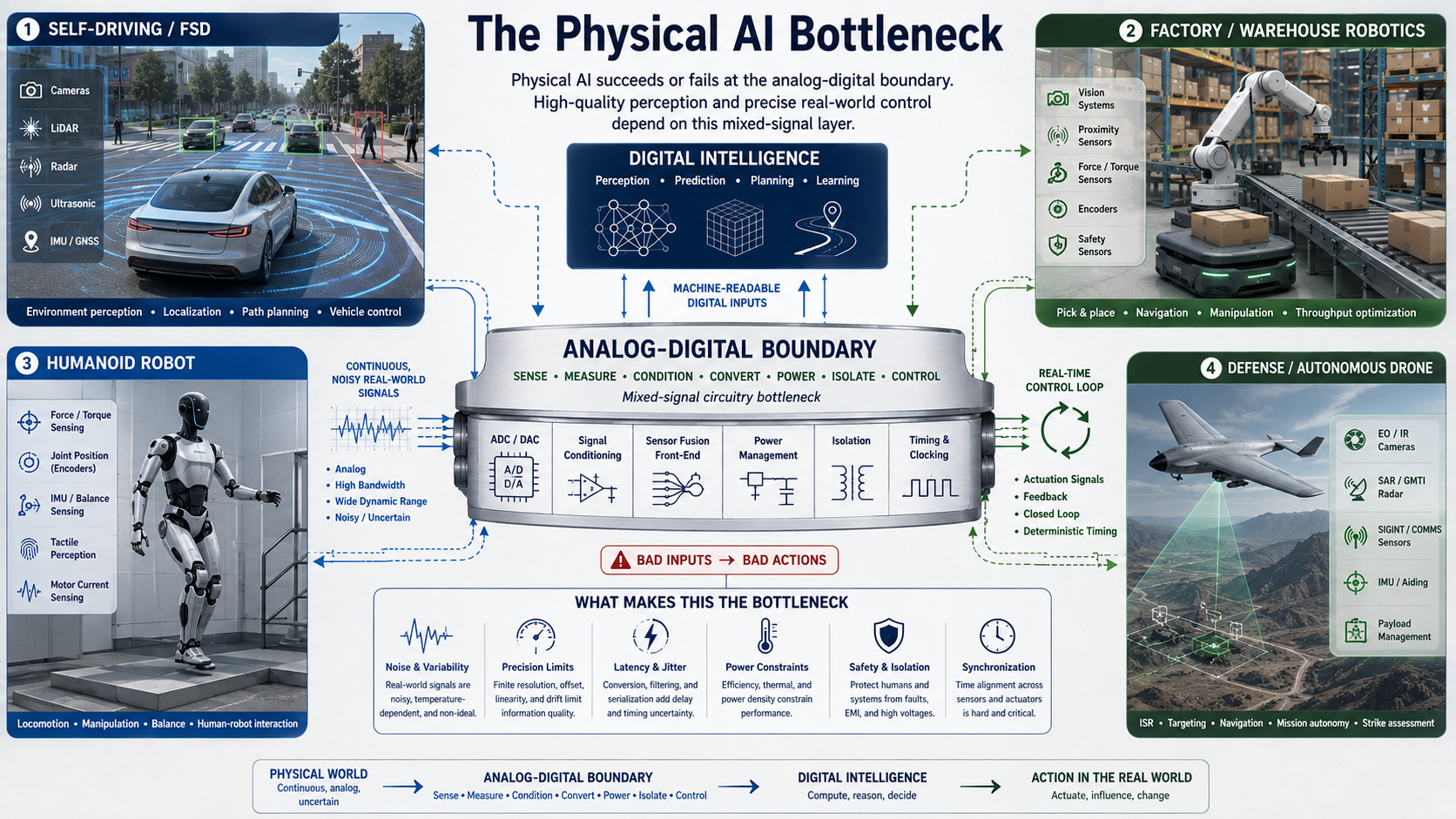
The timing matters because several curves are converging at once. Models are becoming multimodal. Large world models, including work from Fei-Fei Li’s World Labs, are beginning to reason about spatial structure, motion, and physical consistency. Edge compute is becoming more capable. Autonomous driving is moving from handcrafted rules toward learned systems. Industrial robots are moving from fixed, repetitive automation toward machines that can adapt to variable environments. The result is that AI is beginning to move from prediction to actuation – from observing the world to controlling it. That transition increases the value of the hardware layer that makes physical reality legible, reliable, and safe enough for machine control.
As AI moves from prediction to actuation, the cost of bad inputs rises. A chatbot can hallucinate a sentence. A physical AI system can misread distance, misjudge force, damage equipment, overheat a battery, or make the wrong real-time control decision. The market naturally focuses on the visible intelligence layer – models, GPUs, autonomy software, and robots – but intelligence cannot safely act on reality until reality has been sensed, conditioned, converted, powered, isolated, and controlled.
Why This Layer is Hard to Copy
The analog-digital boundary is difficult because it sits where clean digital logic meets messy physical reality. Digital circuits can be abstracted into zeros and ones. Analog and mixed-signal circuits must preserve signal integrity across noise, drift, heat, interference, latency, voltage variation, bandwidth limits, power budgets, safety requirements, and harsh operating environments. An analog-to-digital converter is not a passive translator. It determines how much of reality survives the transition into digital form. Speed, resolution, noise, power, area, and reliability are often in tension. Improving one dimension can degrade another.
That makes this bottleneck hard to solve with software alone. Software can improve perception and control, but it cannot recover information that was never accurately sensed, conditioned, or converted. A model cannot reason from a signal lost in noise, distorted by poor front-end design, delayed by timing errors, or constrained by power and thermal limits. With Physical AI, the physical interface is not peripheral, but it is part of the intelligence stack.
This is why the timing matters. Physical AI is moving from concept to deployment across full self-driving, warehouse automation, humanoids, autonomous drones, software-defined vehicles, electrification, smart factories, edge AI, and AI infrastructure. These systems are becoming more autonomous, more sensor-rich, more power-aware, and more control-intensive at the same time.
The market prices the visible layer first: models, GPUs, cloud platforms, autonomy software, and robots. Those matter, but the less visible bottleneck may compound underneath them. More capable models require more physical perception. More autonomy requires more sensors. More sensors generate more analog signals. More analog signals require more signal conditioning, ADCs, DACs, power management, isolation, timing, connectivity, and control. That is the Physical AI flywheel.
The hidden compounding mechanism is content per system. Physical AI does not merely increase the number of intelligent machines. It increases the amount of mixed-signal hardware required inside each machine. As AI moves from prediction to actuation, the scarce layer may shift from the robot brain to the sense-measure-control layer that lets intelligence safely enter the physical world.

If AI is moving from tokens to machines, the quiet toll road may not be the robot itself, but the analog-digital boundary every intelligent machine must cross before it can act on reality.


Leave a Reply