Thesis: Physical AI is shifting the AI bottleneck from digital intelligence to the analog-digital boundary. As AI moves from tokens to machines, the scarce layer becomes the ability to sense, measure, and control reality. We express that shift through ADI because Physical AI is still in its engineering-performance phase, where signal fidelity, power density, timing, isolation, and system reliability matter more than analog scale. ADI is the cleanest public-market expression of today’s bottleneck: high-performance mixed-signal systems that turn reality into data and intelligence into action.
Review of Latest Earnings
ADI reported Q2 FY26 revenue of $3.62B, up 37% year over year, with adjusted EPS of $3.09, up 67% year over year, and adjusted operating margin of 49.0%. Growth was broad-based across all end markets, with Industrial the largest contributor at 50% of revenue and up 56% year over year. Management attributed Industrial strength to aerospace and defense, automated test equipment (ATE), electronic test and measurement, and broad-market industrial demand. Communications represented 15% of revenue and grew 79% year over year; within Communications, management stated that data center now represents more than 75% of segment revenue and grew more than 90% year over year, driven by both optical and power portfolios. Automotive represented 24% of revenue and grew 2% year over year, with management citing demand for GMSL, functionally safe power, A2B, and battery management. Consumer represented 11% of revenue and grew 23% year over year, though it is less central to the analog-digital boundary thesis than Industrial, Communications, and Automotive.
ADI guided Q3 FY26 revenue to $3.9B, ±$100M, with adjusted operating margin of approximately 49.0%, ±100 bps, and adjusted EPS of $3.30, plus or minus $0.15. On the call, management indicated that Industrial, Automotive, and Communications are expected to grow above seasonal levels sequentially, with Communications expected to be the fastest-growing segment on continued data center demand. Capex was $138M in Q2 and $541M over the trailing twelve months. ADI does not disclose capex by end-market category, so data center should be discussed as a revenue and demand contributor rather than as a separately disclosed capex allocation. Management said FY26 capex is expected to remain within the company’s long-term model of 4% to 6% of revenue, which indicates that ADI is not currently signaling a material step-up in capital intensity to support this growth outlook.
Valuation: What the Market Is Already Pricing
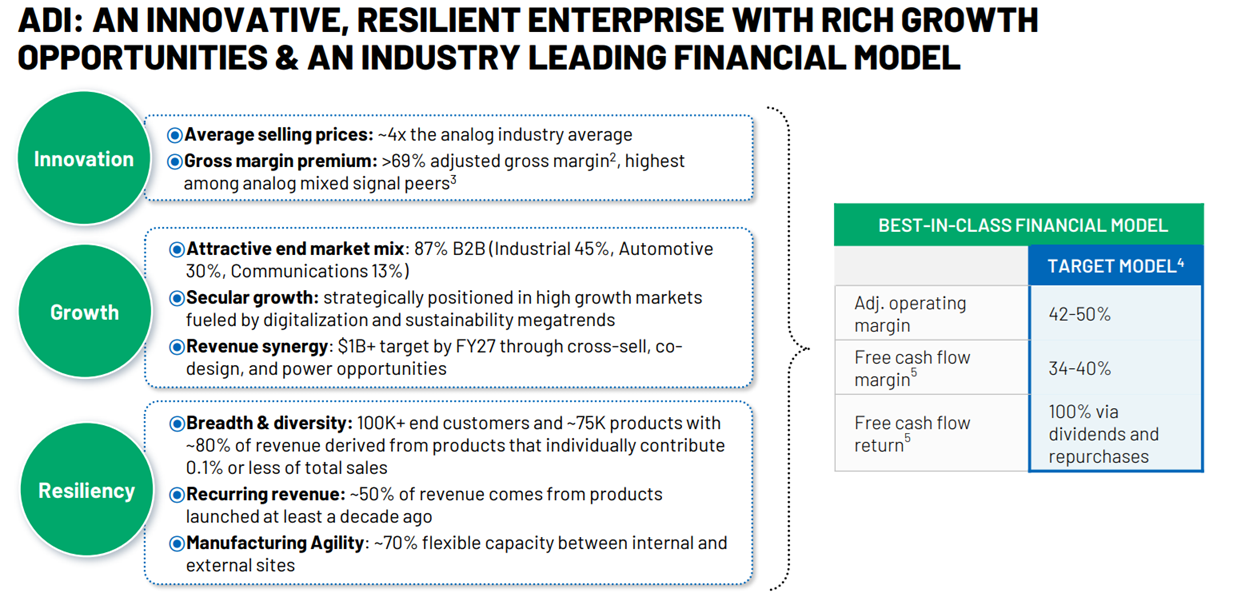
The valuation question is the central underwriting question for ADI. The stock is not being offered as a neglected cyclical value stock. At roughly $387 per share (6/26/26) and a market capitalization near $190 billion, ADI already trades as a premium analog compounder. On trailing GAAP earnings, the stock trades at roughly 58x earnings, though that figure is optically elevated because acquisition amortization and cycle timing distort reported GAAP EPS. A cleaner near-term underwriting anchor is management’s Q3 FY26 adjusted EPS guide of approximately $3.30, or $13.20 annualized, which implies roughly 29x annualized run-rate adjusted earnings. On trailing-twelve-month free cash flow of approximately $4.6 billion, ADI trades at roughly 42x free cash flow, or a free-cash-flow yield of only about 2.4%.
That valuation is not cheap enough for the thesis to be right in a vague way. The investment case requires evidence that ADI’s recent strength is not merely an analog inventory-cycle recovery, but the beginning of a higher-content cycle driven by AI infrastructure, industrial automation, intelligent edge systems, software-defined vehicles, battery management, optical infrastructure, and high-density power delivery.
| Scenarios | What it assumes | Valuation implication |
| Bear case | Q2/Q3 strength is mostly cyclical recovery; Industrial slows; data-center power/optical remains too small to re-rate the company | ADI deserves a premium analog multiple, but the stock is already pricing much of that quality |
| Base case | ADI sustains high margins, modest above-cycle growth, and strong FCF return; Physical AI helps but does not transform the model | Current valuation is defensible but not obviously cheap |
| Bull case | AI infrastructure and Physical AI drive durable content-per-system expansion across data center, industrial, automotive, and intelligent edge | ADI can grow into the current multiple and potentially re-rate as a strategic mixed-signal infrastructure asset |
The key debate is whether the market is valuing ADI as a mature analog supplier when it should increasingly value the company as a strategic mixed-signal infrastructure asset. If Physical AI increases the amount of sensing, measurement, conversion, power, isolation, timing, and control required per system, ADI’s normalized earnings power may be higher than a traditional mid-cycle analog framework implies. If not, the current multiple already discounts much of the quality.
In other words, ADI is not a cheap stock. Its roughly 58x trailing P/E makes that unavoidable. The thesis only works if the market is still underestimating the durability of ADI’s earnings power as AI moves from software into power-hungry, sensor-rich, physically controlled systems.
Why ADI Is the Cleanest Early-Phase Physical AI Play
ADI is the cleanest public-market expression of the early Physical AI bottleneck because early adoption is still an engineering-performance problem, not a mass-volume problem.
In the first phase of a physical technology transition, systems must become reliable before they become ubiquitous. Robots, automated factories, advanced vehicles, medical devices, energy systems, aerospace platforms, and AI infrastructure all need higher-performance sensing, signal conditioning, data conversion, isolation, power management, timing, connectivity, and control before they can scale safely. These are ADI’s core domains.
This is the key distinction: Physical AI does not begin with broad analog volume. It begins with performance at the analog-digital boundary. The early bottleneck is not simply “more analog chips.” It is cleaner signals, denser power, better isolation, more precise measurement, lower noise, higher reliability, and better system-level control.
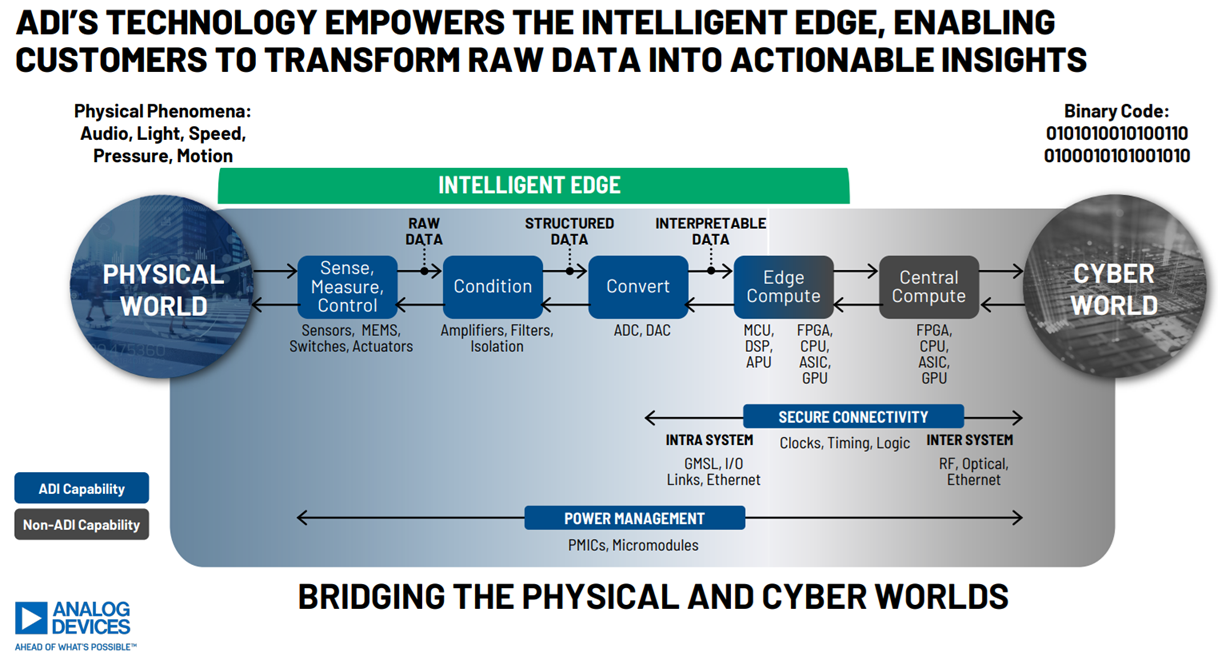
ADI is well positioned for this phase because its franchise is concentrated in high-performance analog and mixed-signal functions where precision and reliability matter. Industrial automation, aerospace and defense, electronic test and measurement, automotive sensing, battery management, data center power, optical infrastructure, and intelligent edge systems all require the same underlying capability: converting messy physical reality into usable information and converting digital intelligence into controlled physical action.
The thesis does not require ADI to own the final robotics platform or AI accelerator. It requires only that more intelligence embedded into more physical systems increases the value of high-performance analog at the boundary between physical reality and digital control.
Moat Analysis
The obvious objection is that every serious semiconductor company has analog design teams. NVIDIA, AMD, Apple, Tesla, Broadcom, Marvell, and other leading chip designers all have mixed-signal teams for SerDes, PLLs, memory interfaces, clocking, power management loops, and sensor interfaces. Even AI labs are increasingly building internal silicon and mixed-signal capability, so on the surface, analog talent can appear commoditized.
However, that does not eliminate ADI’s moat, but defines it more precisely.
Internal mixed-signal teams are usually built to solve analog problems inside a company’s own chips or systems. ADI solves external physical-interface problems across thousands of customers, applications, environments, voltage domains, safety requirements, and product life cycles. There is a major difference between designing analog blocks inside an AI accelerator and building qualified analog products that can sense, measure, isolate, power, protect, convert, connect, and control real-world systems across industrial, automotive, medical, communications, energy, aerospace, and defense-adjacent markets.
ADI’s advantage is not simply analog design talent. It is accumulated analog design, specialized process knowledge, packaging, test, reliability data, field applications expertise, customer qualification, product breadth, and system-level know-how. Physical-world analog is not a single circuit problem. It is a reliability, noise, power, thermal, safety, packaging, and application problem.
This is why ADI remains relevant even when customers have their own analog teams. Large platform companies may internalize narrow proprietary interfaces where vertical control matters, but recreating a full catalog of precision analog, power, isolation, RF, timing, sensing, and conversion products across every physical end market is unattractive. There are too many niches, too many qualification cycles, too much field support, too much liability, and too little advantage versus using proven components.
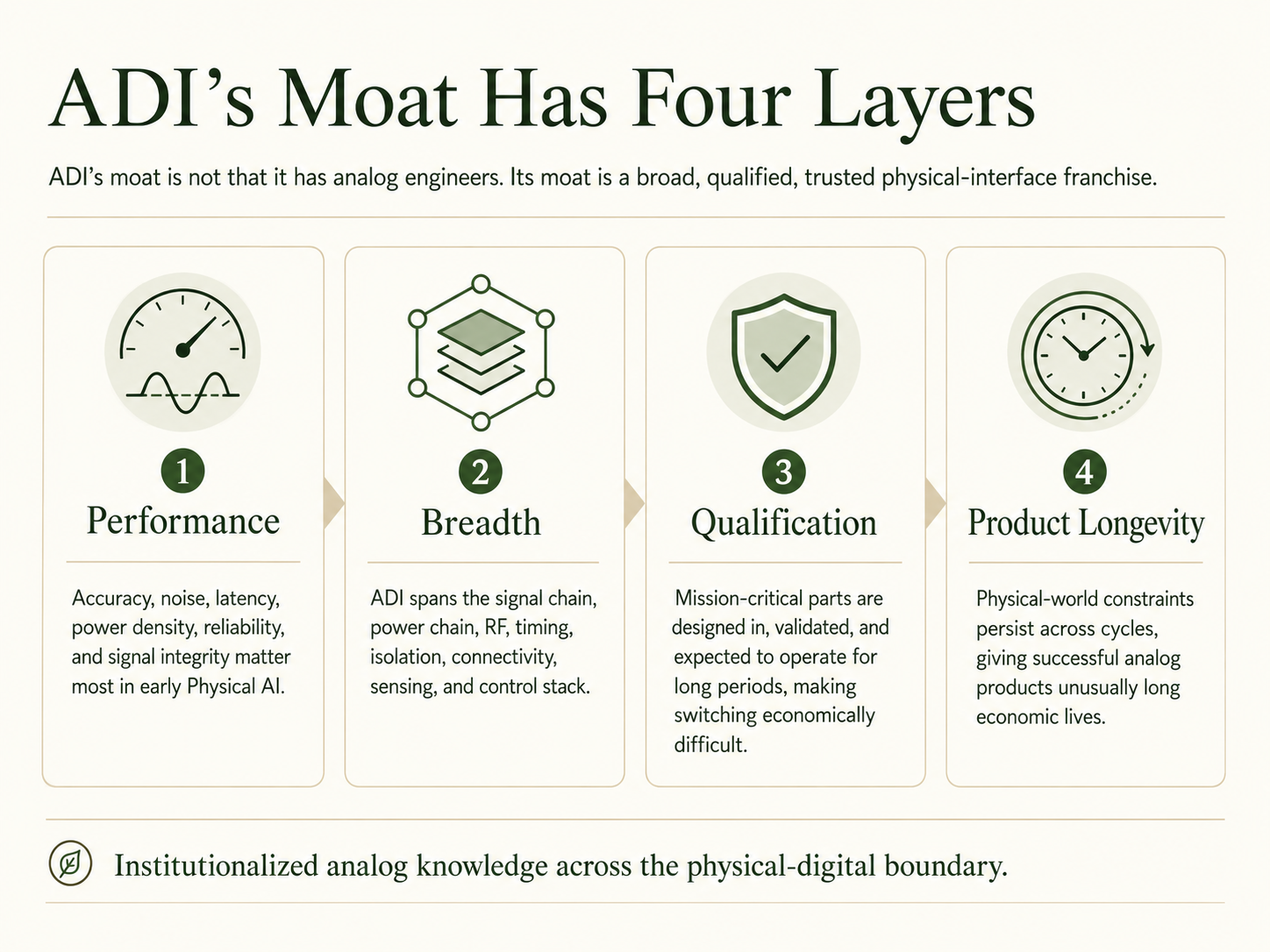
ADI’s moat has four layers: performance, breadth, qualification, and product longevity. Performance matters because early Physical AI requires accuracy, low noise, power density, reliability, and signal integrity. Breadth matters because ADI spans the signal chain, power chain, RF, timing, isolation, connectivity, sensing, and control stack. Qualification matters because mission-critical parts are designed in, validated, and expected to operate for long periods, making switching economically difficult. Product longevity matters because physical-world constraints persist across cycles, giving successful analog products unusually long economic lives.
ADI’s moat is not simply top analog talent. It is the institutionalization of analog knowledge into a broad, qualified, trusted physical-interface franchise.
Why We Exclude the Rest
Texas Instruments (TXN) is the most important exclusion. TXN is a world-class analog and embedded processing company with enormous scale, manufacturing depth, 300mm capacity advantages, broad distribution, and deep exposure to industrial and automotive markets. It may be the better broad analog compounder.
But TXN is not the cleanest expression of this specific thesis. TXN is primarily a broad analog, embedded processing, manufacturing-scale, and free-cash-flow story. ADI is the cleaner expression of high-performance analog at the physical interface: precision signal chain, mixed-signal conversion, RF, isolation, power management, connectivity, sensing, and control. For the early phase of Physical AI, we prefer the company more exposed to performance-critical analog complexity over the company more exposed to broad analog and embedded scale.

Monolithic Power Systems (MPWR) is a high-quality power-management company with meaningful AI and data center exposure, but its exposure is narrower. MPWR is more directly tied to power conversion and high-performance power modules, while ADI offers broader exposure across power, signal chain, data conversion, sensing, timing, isolation, and control.
onsemi (ON), Infineon Technologies (IFNNY), and STMicroelectronics (STM) are important electrification, automotive, industrial, and power semiconductor beneficiaries, but they are more exposed to power discretes, automotive cycles, manufacturing execution, and electrification-specific demand than to the full analog-digital boundary.
NXP Semiconductors (NXPI), Renesas Electronics (RNECY), and Microchip Technology (MCHP) have strong embedded control, automotive, industrial, and microcontroller franchises, but their exposure is more blended across MCUs, embedded processing, connectivity, automotive platforms, and broad industrial semiconductors. They are important Physical AI ecosystem players, but less pure as precision analog and mixed-signal bottleneck owners.
Broadcom (AVGO), Marvell (MRVL), Credo Technology (CRDO), and MACOM Technology Solutions (MTSI) are credible beneficiaries of AI infrastructure, SerDes, DSPs, RF, and high-speed data movement, but their exposure is more tied to digital networking, data-center interconnect, and connectivity silicon than to the broader physical-world analog interface.
The goal here is not to dismiss these companies, some of which may be excellent businesses or compounders in their own right (like TXN). It is to isolate the cleanest public-market expression of the early Physical AI bottleneck: ADI for high-performance analog, mixed-signal conversion, power, sensing, isolation, RF, connectivity, timing, and control at the analog-digital boundary.
What Could Break the Thesis
1. Physical AI adoption is slower than expected
Robotics, intelligent automation, autonomous systems, medical devices, and sensor-rich industrial platforms may take longer to scale than investors expect.
2. This is just an analog-cycle recovery
ADI’s recent growth may reflect inventory normalization and cyclical recovery rather than a durable secular inflection in physical AI, data center power, sensing, and control.
3. Broad analog scale matters more than performance analog
TXN or other broad analog competitors may prove to be better positioned if cost, manufacturing scale, distribution, and embedded breadth matter more than precision signal-chain complexity.
4. Customers internalize more of the stack
Large platform companies may use internal mixed-signal teams to design proprietary analog functions where performance, cost, or system control justify vertical integration.
5. ADI is important but does not capture enough economics
Customers can dual-source, pressure pricing, or shift value to system vendors, compute platforms, automation companies, or internal silicon teams.
6. Cyclical volatility masks the structural signal
Industrial capex, automotive demand, distributor behavior, tariffs, export controls, manufacturing delays, and supply-chain disruptions can dominate near-term results even if the long-term analog-digital boundary thesis remains intact.
Investment Conclusion
The investment case for ADI is not that it is an obvious AI winner. It is that the next phase of AI adoption may increase the value of high-performance analog and mixed-signal content at the boundary between digital intelligence and physical systems.
The market has already priced many of the direct AI infrastructure beneficiaries more explicitly: compute, memory, networking, and cloud capex. ADI offers a different exposure. Its value proposition is tied to sensing, measurement, power management, isolation, conversion, RF, timing, connectivity, and control – functions that become more important as intelligence is embedded into industrial systems, vehicles, energy infrastructure, medical devices, automation, and AI infrastructure.
The distinction versus peers is thesis purity. TXN may be the better broad analog compounder. MPWR may be the more direct power-management trade. AVGO and MRVL may be better data-center connectivity plays. However, ADI is the cleaner expression of performance-critical analog complexity across the physical interface.
The thesis does not require ADI to become a hypergrowth AI company. It requires evidence that higher system complexity translates into durable content growth, margin resilience, and continued customer demand across Industrial, Communications, Automotive, and Intelligent Edge applications.
That makes ADI a more measured AI-adjacent position rather than a pure AI acceleration trade. The upside case is a gradual reframing from premium cyclical analog supplier to strategic mixed-signal infrastructure asset. The downside case is that the recent strength proves to be cyclical, broad analog scale matters more than performance analog, or customers capture more of the economics.
On balance, ADI is the cleanest single-name expression of the early Physical AI analog-digital boundary thesis.


Leave a Reply